

Medicare open enrollment ends December 7, and a few minutes of checking now can protect your access to your doctors for all of 2027. Every fall, during Medicare open enrollment, Medicare plans adjust their premiums, benefits, drug lists, and the doctors and hospitals they include. This year, several large Medicare Advantage insurers, including UnitedHealthcare, are narrowing their provider networks by removing physicians from their plans. Those removals are the insurer’s decision, not the doctor’s. A plan that worked well for you in 2026 may not include the doctor you trust in 2027.
At Altitude, we care for a large senior population, and we want you to make this decision with clear information. This guide covers the key dates for Medicare open enrollment, the differences between your options, a simple checklist for confirming your care team, and what to do if something does not line up.
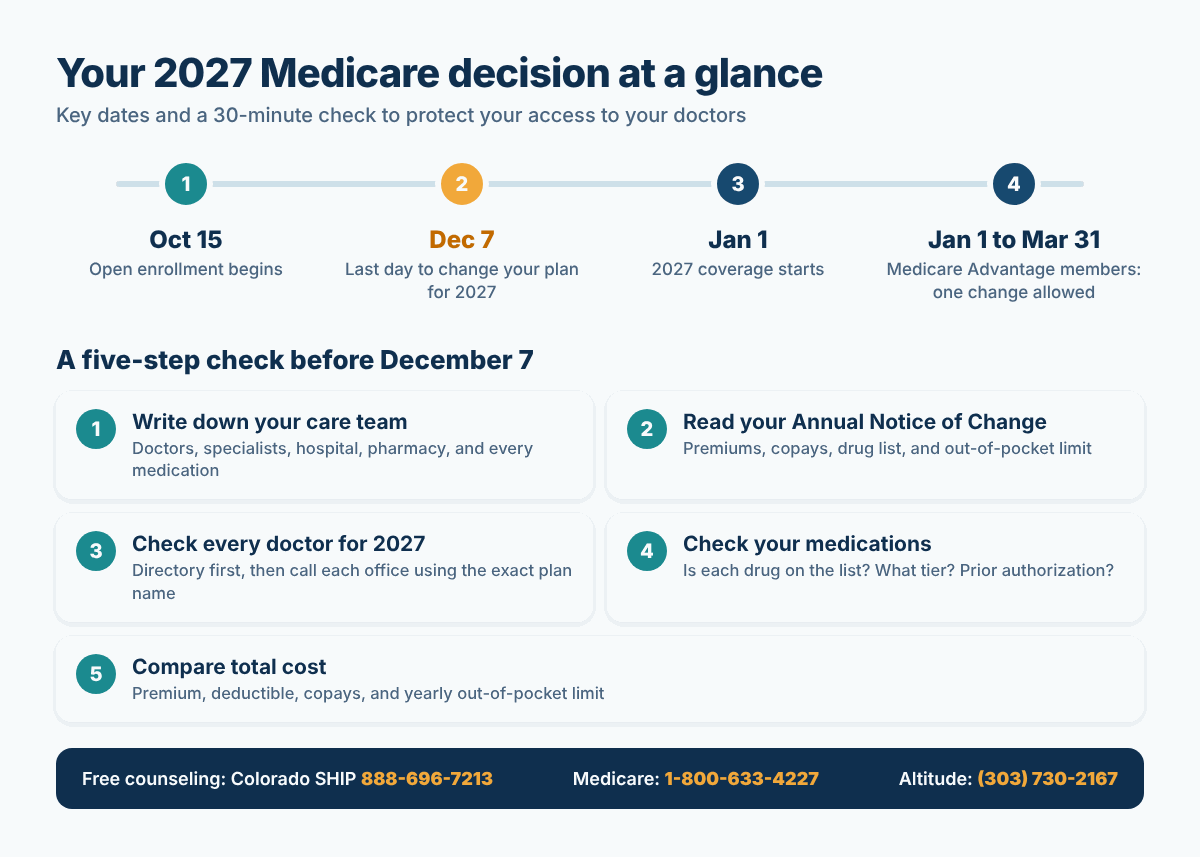
The dates to know for Medicare open enrollment
Medicare open enrollment gives you until December 7 to change your Medicare plan for 2027. If you already have Medicare Advantage, a second and narrower window opens after the new year.
| Window | Dates | Who can use it | What you can do |
|---|---|---|---|
| Annual open enrollment | Oct 15 to Dec 7, 2026 | Everyone with Medicare | Switch Medicare Advantage plans, move between Medicare Advantage and Original Medicare, or change your drug plan. Changes start Jan 1, 2027. |
| Medicare Advantage Open Enrollment | Jan 1 to Mar 31, 2027 | Only people already in a Medicare Advantage plan | One change: switch to a different Medicare Advantage plan, or return to Original Medicare with a stand-alone drug plan. |
If you are happy with your plan and it still includes your doctors, you do not have to do anything during Medicare open enrollment. But do not let it renew on autopilot. Every Medicare Advantage and drug plan mailed an Annual Notice of Change this fall, and it is worth reading, because it spells out what is different for next year.
Your options in plain language
Most people choose between two paths: Original Medicare with a drug plan and a Medigap (secondary) supplement, or a Medicare Advantage plan that bundles everything together. Many people assume Medicare Advantage is the default, but Original Medicare with a Medigap plan is often a strong and cost-effective choice. Your costs are more predictable, and you avoid much of the burden of networks, referrals, and prior authorizations. Neither is right for everyone. The biggest practical difference is who decides which doctors you can see.
| Original Medicare (plus drug plan, often plus Medigap) | Medicare Advantage | |
|---|---|---|
| Choosing doctors | Any provider in the U.S. who accepts Medicare. There is no insurer network that can remove your doctor. | Only providers in your plan’s network (HMO or PPO) |
| Referrals and approvals | Generally no referrals or prior authorization for covered care | Referrals (HMO) and prior authorization are common |
| What you pay | Part B premium, a drug plan, and a Medigap premium. Medigap picks up much of the cost sharing, so your bills are more predictable. | Part B premium, often a low plan premium, then copays and coinsurance up to a yearly out-of-pocket limit |
| Extras | None built in | Often dental, vision, hearing, and drug coverage |
| Year-to-year changes | Medicare coverage stays the same. Medigap and drug plan prices can change. | Network, copays, and benefits can all change every January |
| Switching later | Joining Medicare Advantage later is generally easy | Going back to Original Medicare is possible, but in most states a Medigap insurer can ask health questions and may decline you or charge more |
That last row matters. Before you leave Medicare Advantage for Original Medicare, confirm that you can actually buy the Medigap plan you want. Colorado publishes a Medigap guide that explains the rules.
What is changing in Medicare Advantage for 2027
Large Medicare Advantage insurers, including UnitedHealthcare, are narrowing their provider networks by removing physicians from their plans, and they are trimming plan offerings for 2027. We have seen network changes in prior years, but they are getting more significant this year. Recent reporting shows how much is shifting:
- UnitedHealthcare says fewer of its members will have access to both HMO and PPO options in 2027, down from over 70% in 2026 (Newsweek).
- An analyst note reported by Axios says UnitedHealthcare dropped about 13% of the plans it offers across 18 states (Axios).
- Humana will offer plans in more than 80% of U.S. counties, down from 85%, and Aetna will be in 41 states, down from 43 (Newsweek).
- About 34 million people are expected to be in Medicare Advantage plans in 2027, down roughly 6% (Beinsure).
- Many plans are also trimming extras such as dental coverage and raising specialist copays (Axios).
What does that mean for you? A network is a list of doctors and hospitals that an insurer chooses to include, and the insurer decides who stays on it. When a physician is removed from a plan’s network, that is the insurer’s decision. It is not the doctor opting out, and it says nothing about the quality of your care. It can, however, change whether your plan pays for the visit, and your doctor has little power to prevent it. Network changes do not automatically mean you lose coverage, but they can mean your preferred doctor or hospital is suddenly out of network, so confirm your doctors every year rather than assuming they are still included.
A five-step check before Medicare open enrollment ends
This takes about 30 minutes, and it is the single best thing you can do this month.
- Write down your care team. List your primary care doctor, every specialist, your preferred hospital and urgent care, your pharmacy, and each medication with its dose.
- Read your Annual Notice of Change. Look for changes to premiums, copays, the drug list, and the out-of-pocket limit.
- Check every provider in your plan’s directory for 2027. Then call each office and confirm by the exact plan name, not just the insurer. Directories are sometimes out of date, and one insurer can sell many plans with different networks.
- Check your medications. Confirm each drug is on the plan’s list, note its tier and any prior authorization, and confirm your pharmacy is in network.
- Compare total cost, not just the premium. Add up the premium, deductible, specialist copays, and the yearly out-of-pocket limit for the care you expect to use.
The Medicare Plan Finder at Medicare.gov lets you enter your medications and compare plans in your zip code. If you would rather talk to a person, Colorado’s State Health Insurance Assistance Program (SHIP) offers free, unbiased Medicare counseling at 888-696-7213. We cannot recommend specific insurance plans, but we can refer you to an insurance broker who can help you compare your options, at no charge to you.
If your doctor is not in your 2027 network
You still have choices, and the best time to use them is now, while Medicare open enrollment is still open.
- Ask about continuation of care. If you are in the middle of treatment, such as ongoing cancer care, a pregnancy, or recovery from surgery, ask your plan in writing whether you can keep seeing your current doctor for a transition period, and ask your doctor’s office to support the request. Your plan’s termination notice is required to explain how to make this request. Approval and length depend on your plan and your situation, so ask early.
- Switch to a Medicare Advantage plan that includes your doctors. Compare plans using the same five-step check. Make sure the new plan covers your doctors and your medications before you commit.
- Move to Original Medicare. This gives you the widest choice of doctors, no insurer network that can remove them, and generally fewer prior authorizations and approvals. You will need a drug plan, and you may want a Medigap supplement. Apply for the Medigap plan and confirm you are accepted before you cancel your Medicare Advantage plan, because in most states a Medigap insurer can ask health questions.
- Wait for the January window. If you are in a Medicare Advantage plan, you get one change between Jan 1 and Mar 31, 2027. The catch is that you would start the year in a plan that may not include your doctor.
- Do not cancel anything until the new coverage is confirmed in writing. A gap in coverage is much harder to fix than a late decision.
For questions about your specific situation, call 1-800-MEDICARE (1-800-633-4227) or Colorado SHIP at 888-696-7213. Both are free, and neither is selling you a plan.
If your insurer removes your doctor
If your plan ends your doctor’s contract, you are not without options. Medicare sets rules for what your plan must tell you, and there are steps you can take right away.
- You must get advance notice. A plan has to notify you when it removes a provider, whether or not the removal was for cause. For a primary care or behavioral health provider, the rule is at least 45 days of written notice before the termination date. For other specialists, it is at least 30 days (eCFR 42 CFR 422.111).
- The notice must explain how to ask for continued care. It has to give the end date, list in-network alternatives, and explain how to request continuation of ongoing treatment with your current provider (eCFR 42 CFR 422.2267). If you are in the middle of treatment, ask your plan in writing right away, and ask your doctor’s office to support the request. How long continued access lasts depends on your plan and your situation.
- You may qualify for a special enrollment period. People affected by a significant change in a plan’s provider network can switch to another Medicare Advantage plan or to Original Medicare, once per change. The window starts when you are notified and runs for two more months (eCFR 42 CFR 422.62). Medicare decides what counts as a significant change, so call 1-800-MEDICARE (1-800-633-4227) and ask whether your situation qualifies.
- File a complaint and get help. You can file a complaint with your plan, and Colorado SHIP (888-696-7213) can help you with the process at no cost. Keep a record of every call, including the date, the name of the person, and any reference number, and ask for answers in writing.
Physicians often appeal these insurer decisions on behalf of their patients, but insurers can be very difficult to work with, and the process can be slow with no guarantee of success. Please do not wait for an appeal to be resolved before protecting your own care. Make a backup plan, use the steps above, and tell your doctor’s office what you decide.
Why so many seniors choose Altitude
Choosing a plan during Medicare open enrollment is only half of good Medicare care. The other half is having a primary care team that knows you, keeps you well, and helps you navigate the system. As independent doctors, that is what we are built to do.
- Quality: Our senior patients score in the 97th percentile on quality measures.
- Value: Our patients over 65 cost the system about $2,000 less per person each year than the national average for seniors. Better primary care means fewer avoidable emergency visits and hospital stays, and that is good for your health and for Medicare.
- Access: Two convenient locations in Littleton and Arvada, with a team that knows you.
- Prevention first: Our Senior Wellness approach focuses on annual wellness visits, screening, medication review, and keeping you independent.
Whichever plan you choose, we want to be your doctors. Call us if you have questions about how a plan works with our practice.
Common questions about Medicare open enrollment
Do I have to do anything during Medicare open enrollment if I like my plan?
No. If you do nothing, your current plan generally renews. But read your Annual Notice of Change first, because the plan can change even when you do not.
Is Original Medicare always better than Medicare Advantage?
No. Medicare Advantage can offer lower premiums and extra benefits, and many people are very happy with it. The tradeoff is a network and prior authorization. The right choice depends on your doctors, your health, and your budget.
If my doctor is out of my plan’s network, did my doctor choose to leave?
Usually not. Insurers decide who is in their networks, and they can remove a physician even when the physician wants to stay. A doctor can accept Original Medicare and still be out of network for a particular Medicare Advantage plan.
Can I still switch after Medicare open enrollment ends December 7?
If you are in Medicare Advantage, you can make one change between January 1 and March 31. If you are on Original Medicare, your options after December 7 are much more limited.
Will my medications still be covered?
Check. Drug lists, tiers, and pharmacy networks can change every year, so look up each of your medications before you decide.
Questions about Medicare open enrollment? Talk with us
If you are not sure how your plan works with your doctors, or you want help with Medicare open enrollment before December 7, call us at (303) 730-2167 or schedule a visit at our Littleton or Arvada clinic. We cannot recommend specific insurance plans, but we are happy to refer you to an insurance broker, whose help is free to you. Our team can also help you prepare for an annual wellness visit before the year ends.
This article is for general information only. It is not individual insurance, legal, or medical advice. Medicare rules and plan details change, so confirm specifics with Medicare, your plan, or Colorado SHIP.
Sources
- Newsweek: Insurers tightening Medicare Advantage networks next year
- Axios: Medicare Advantage plans appear to be cutting benefits in 2027
- Beinsure: U.S. insurers narrow Medicare Advantage provider access
- Medicare Resources: Medicare enrollment dates at a glance
- AARP: Medicare open enrollment
- Colorado Division of Insurance: Senior health care and Medicare (SHIP)
- eCFR: 42 CFR 422.111, provider termination notice
- eCFR: 42 CFR 422.2267, required notice content
- eCFR: 42 CFR 422.62, special enrollment periods