Fall prevention starts before the first icy morning. In Colorado, winter brings ice, early darkness, and more chances to slip. For someone with strong bones and good balance, a fall is usually a bruise. For someone with thin bones, the same fall can mean a broken hip or wrist, a hospital stay, and a long recovery. The good news is that both halves of the problem, weak bones and falls, can be addressed.
This guide to fall prevention and osteoporosis explains what osteoporosis is, who should be screened, why falls happen, and what you can do at home and in our office to protect your bones and your independence.
Osteoporosis is silent, which is why fall prevention matters
Osteoporosis means your bones have lost density and internal structure, so they break under forces that healthy bone would handle. It causes no pain and no symptoms on its own. Many people find out only after a fracture from a fall at standing height or less, which doctors call a fragility fracture.
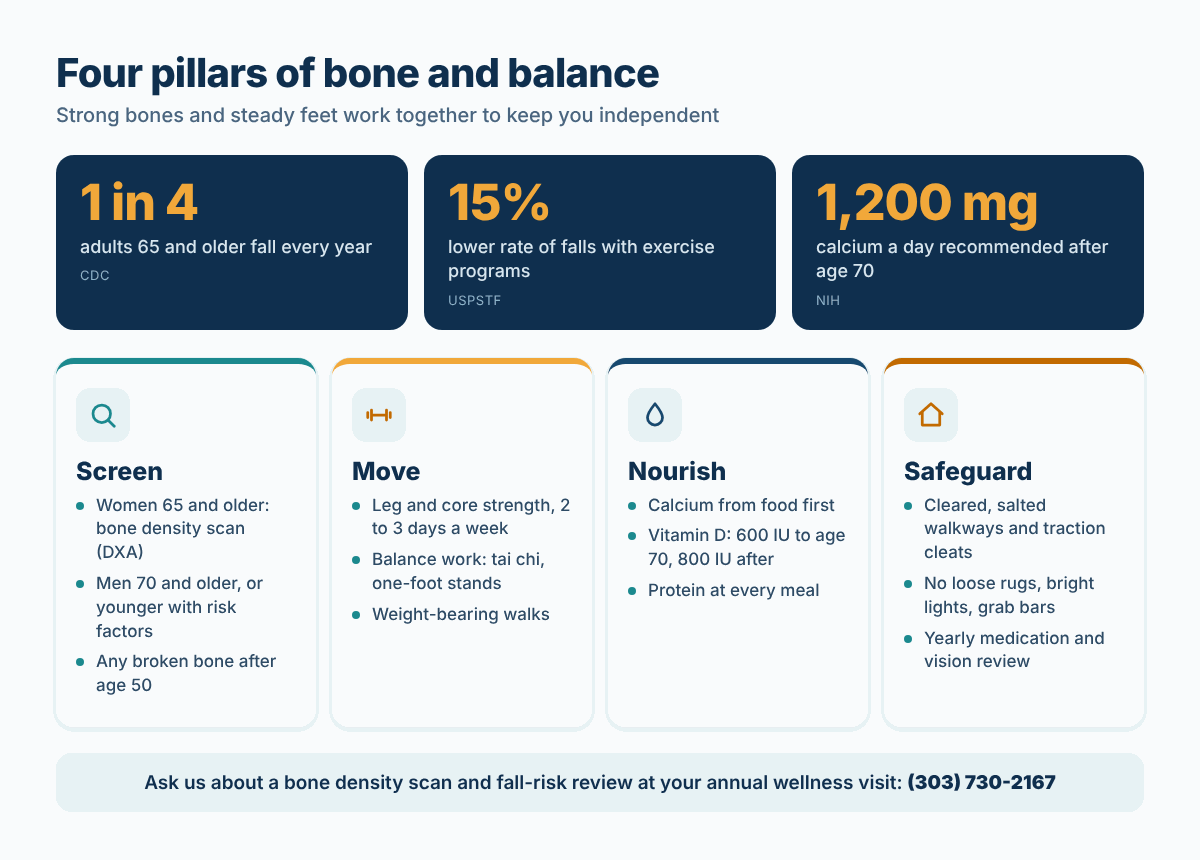
It is common. The U.S. Preventive Services Task Force reports that 12.6% of adults 50 and older have osteoporosis, including 27.1% of women and 5.7% of men aged 65 and older. Falls are the leading cause of injury in older adults, and the CDC reports that 1 in 4 adults 65 and older falls every year. The CDC also notes that the age-adjusted fall death rate in older adults rose 21% from 2018 to 2024. Good fall prevention protects you from both problems at once.
Things that raise your risk of thin bones include:
- Age, and menopause for women
- A family history of osteoporosis or hip fracture
- A previous broken bone after age 50
- Smoking and heavy alcohol use
- Long-term steroid use such as prednisone
- Low vitamin D, poor absorption of nutrients, and low body weight
- Low activity, especially little weight-bearing exercise
Men get osteoporosis too. They are screened less often, so it is more likely to be missed.
Who should get a bone density scan
If you are a woman 65 or older, you should have a bone density scan. Other groups should be screened earlier, depending on risk, and guidelines differ slightly for men.
| Who | Recommendation | Source |
|---|---|---|
| Women 65 and older | Screen with a bone density scan (DXA) | USPSTF |
| Postmenopausal women under 65 with risk factors | Screen if risk assessment shows increased risk | USPSTF |
| Men 70 and older | Screen | BHOF |
| Men 50 to 69 with risk factors | Screen | BHOF |
| Anyone who broke a bone after age 50 | Screen | BHOF |
The USPSTF says the evidence for routine screening in men is still insufficient, which is why the Bone Health and Osteoporosis Foundation’s risk-based approach is useful for men.
A DXA scan is fast and painless, with very low radiation. It reports a T-score, and a T-score of -2.5 or lower means osteoporosis. We often pair the result with a risk calculator called FRAX, which estimates your 10-year chance of a major fracture. If you have never had a scan, or you are not sure when your last one was, ask us at your next annual wellness visit. Medicare generally covers bone density testing for people who meet its criteria, and our team can check your coverage.
Why falls happen, and what fall prevention can change
Falls are rarely just bad luck. The CDC points to poor strength and balance and to medicines that raise fall risk, and most people have several contributing factors that can each be improved.
| Contributor | What it looks like | What helps |
|---|---|---|
| Weak legs and poor balance | Trouble standing from a chair, unsteady turning | Strength and balance training |
| Medications | Dizziness, drowsiness, confusion | A medication review with your doctor |
| Blood pressure drops | Lightheaded when you stand up | Checking standing blood pressure, adjusting medicines, hydration (see our blood pressure guide) |
| Vision and hearing | Missed curbs, trouble in dim light | Yearly eye exam, updated glasses |
| Foot problems and nerve damage | Numb feet, painful or unstable footing | Foot care, supportive shoes, treating the cause |
| Home hazards | Loose rugs, poor lighting, clutter, bathrooms without grab bars | A home safety check |
Certain medications deserve special attention. Sleep aids, sedatives, some anxiety and pain medicines, some antidepressants, and many over-the-counter sleep or allergy products can cause drowsiness or dizziness. Please do not stop any prescribed medication on your own. Bring everything you take, including supplements and over-the-counter products, to your visit and let us review the list together.
Fall prevention you can start today: building and protecting bone
The most useful thing most people can do is move, and the evidence for that is stronger than the evidence for pills. The USPSTF recommends exercise for fall prevention in adults 65 and older who are at increased risk, and the trials it reviewed showed about a 15% lower rate of falls. Good fall prevention programs combine balance, leg strength, and walking.
- Strength training two to three days a week for your legs, hips, and core.
- Balance work such as tai chi, standing on one foot beside a counter, or heel-to-toe walking.
- Weight-bearing activity like walking, hiking, or stairs, which gives bones a reason to stay strong.
- Protein at each meal to protect muscle, which protects you from falling.
- Calcium from food first. The National Institutes of Health recommends 1,000 to 1,200 mg per day depending on your age and sex, and 1,200 mg for everyone over 70. Dairy, fortified foods, canned fish with bones, and leafy greens all count.
- Vitamin D at 600 IU daily through age 70 and 800 IU after that, with a blood test if we suspect a deficiency.
- Quit smoking and keep alcohol modest.
A word on supplements. The USPSTF recommends against taking 400 IU or less of vitamin D and 1,000 mg or less of calcium for the primary prevention of fractures in postmenopausal women, and it does not recommend vitamin D to prevent falls in healthy older adults. Supplements make the most sense when you are actually low or cannot get enough from food. We can check your levels rather than guess.
When medication is the right answer
If a scan shows osteoporosis, or you have had a fragility fracture, it is time to talk about medication. The Bone Health and Osteoporosis Foundation notes that all of the approved drugs reduce the likelihood of fragility fractures. Treating early matters, because one fracture raises the chance of another.
| Type | Examples | How it is taken |
|---|---|---|
| Bisphosphonates | Alendronate, risedronate, ibandronate, zoledronic acid | Weekly or monthly pill, or a yearly infusion |
| RANKL inhibitor | Denosumab | Injection every 6 months |
| Anabolic (bone-building) | Teriparatide, abaloparatide, romosozumab | Daily or monthly injection for a limited time |
| Hormone-related | Raloxifene, estrogen therapy | Daily |
The right choice depends on your fracture risk, your kidney function, your other conditions, and your preferences. Two points are worth knowing. Some drugs, including denosumab, stop working soon after you stop taking them, so we plan the next step before pausing. And very rare side effects such as jaw or thigh-bone problems are far less common than the fractures these medicines prevent, but a dental check before starting is a good idea.
Winter fall prevention: proofing your home and your walk
A few small changes remove most of the hazards that cause winter falls. Use this fall prevention checklist.
Outside
- Wear shoes or boots with deep, non-slip soles, and add traction cleats on icy days
- Keep walkways, steps, and your car’s parking spot cleared and salted
- Take shorter steps on ice, keep your hands free, and let a railing help you
- Ask someone to shovel for you if you are unsteady, rather than risking it
Inside
- Remove loose rugs and tape down cord and mat edges
- Put in bright bulbs, nightlights between the bedroom and bathroom, and light switches at each entry
- Add grab bars in the shower and by the toilet, and a non-slip mat in the tub
- Keep the paths between rooms free of clutter
- Wear supportive slippers or shoes with backs, not socks alone
- Stand up slowly after sitting or lying down
- Keep a phone within reach, and consider a medical alert device if you live alone
Common questions about fall prevention and osteoporosis
Is osteoporosis just a normal part of aging?
Bone loss is common with age, but fractures are not inevitable. Screening, exercise, good nutrition, and treatment when needed change the outcome.
What is the best exercise for fall prevention?
The best programs combine balance, leg strength, and walking. In the trials the USPSTF reviewed, exercise programs lowered the rate of falls by about 15%. Ask us which program fits your health and mobility.
Do men need bone density scans?
Some do. Guidelines suggest considering a scan for men 70 and older, and for men 50 to 69 who have risk factors such as steroid use, a previous fracture, or heavy alcohol use.
Should I just take calcium and vitamin D?
Not automatically. Get calcium from food where you can, and we can check your vitamin D level before recommending a dose. Large doses can cause harm.
Does walking count as exercise for my bones?
Yes, it helps, and it is a good start. Add strength and balance work for the biggest drop in fall risk.
Are osteoporosis medications safe?
For most people the benefit is much greater than the risk. We review your kidneys, teeth, and other conditions first, and we monitor you over time.
I have already fallen. Is it too late?
No. A fall is a signal to act. Tell us about it, even if you were not hurt, so we can look for the cause.
Take the first step in fall prevention this month
At your annual wellness visit, we can review your fall risk, your medications, your vision and balance, and whether you are due for a bone density scan. Call us at (303) 730-2167 or schedule a visit at our Littleton or Arvada clinic before the snow settles in. If you have fallen or you are worried about your balance, tell us when you call so we can book enough time.
This article is for general information only and is not a substitute for individual medical advice. Talk with your doctor before starting an exercise program, changing a medication, or starting a supplement.
Sources
- CDC: Older adult falls data
- USPSTF: Osteoporosis screening to prevent fractures (2025)
- USPSTF: Falls prevention in community-dwelling older adults, interventions (2024)
- Bone Health and Osteoporosis Foundation: Bone density testing
- Bone Health and Osteoporosis Foundation: Medicines for prevention and treatment
- NIH Office of Dietary Supplements: Calcium
- NIH Office of Dietary Supplements: Vitamin D